
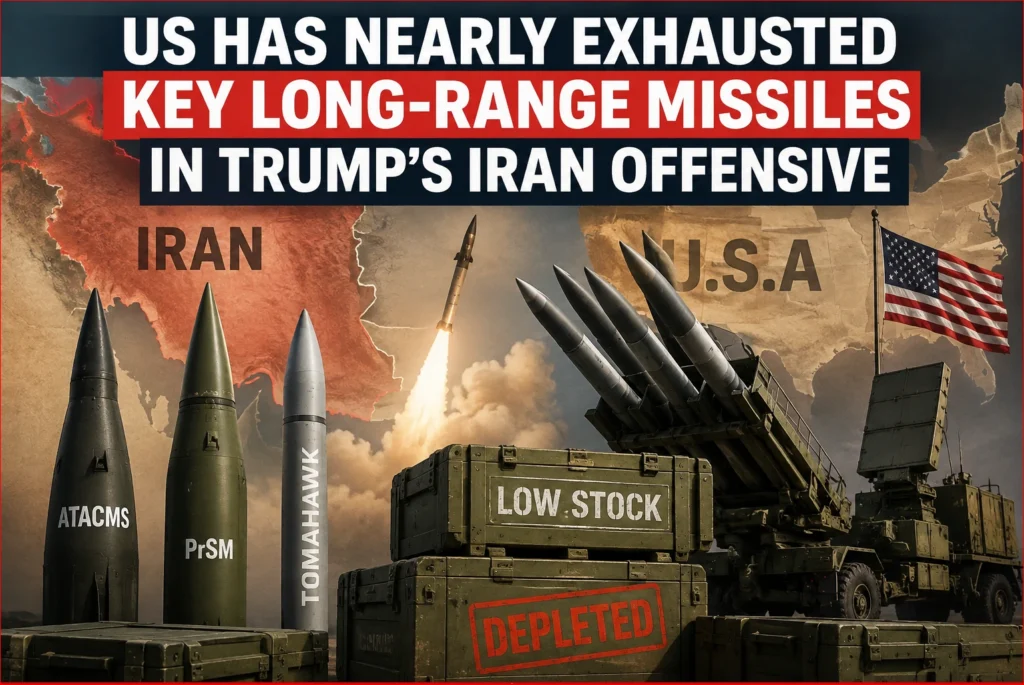
Here’s something that should worry anyone paying attention to America’s military readiness: the Pentagon is reportedly running dangerously low on some of its most important long range missiles. After nearly five months of fighting in Iran, the numbers are apparently so bad that officials inside the government are quietly panicking about what happens if another crisis breaks out somewhere else. The White House, of course, says there’s nothing to see here. But the details coming out tell a different story.
What the Report Actually Says
According to people familiar with internal Pentagon data, the US Army has used up virtually all of its Army Tactical Missile Systems (ATACMS) and its newer Precision Strike Missiles (PrSM) since the war with Iran started. These aren’t minor weapons they’re the ones that let American forces hit targets accurately from far away, without sending pilots into airspace bristling with enemy defenses. Losing that capability, even temporarily, is a big deal.
Nobody’s saying exactly how many missiles are left. The sources spoke on condition of anonymity, and the exact figures are apparently sensitive enough that they’ve only just started making the rounds in government meetings over the past week or so.
CENTCOM Is Scraping the Bottom of the Barrel
One person familiar with the situation put it plainly: US Central Command, which runs American operations across the Middle East, has nearly burned through the land-based missiles it had stockpiled before the war even began. To keep operations going, CENTCOM has reportedly had to pull in extra missiles from stockpiles elsewhere around the world essentially robbing Peter to pay Paul.
Tomahawks and Missile Defense Are Feeling It Too
It’s not just ATACMS and PrSM. The US has also apparently used up nearly half its global supply of Tomahawk cruise missiles since the fighting started. And on the defensive side, a report from the Center for Strategic and International Studies found that stocks of Patriot and THAAD interceptors have dropped sharply from where they stood before the war down to a fraction of earlier numbers, thanks to a combination of wartime use, past shipments to Ukraine, and years of the US simply not building enough of these things.
Why Should Anyone Outside Iran Care?
Because This Is About More Than One War
These long range missiles aren’t just useful against Iran they’re considered essential for deterring far bigger threats, like Russia or China. If the US doesn’t have enough left in reserve, that’s a real problem the next time something serious kicks off somewhere else in the world. Analysts have been sounding the alarm about exactly this scenario for a while now.
There are also reports that military leaders have been quietly warning the White House for weeks that interceptor stockpiles in particular were getting worryingly thin. That’s reportedly part of why Trump recently decided to hold off on launching another big offensive inside Iran at least for now.
How Did It Get This Bad?
This didn’t happen overnight. Decades of shrinking stockpiles after the Cold War, a defense industry built for peacetime production instead of wartime surges, and Pentagon budgets that have always favored big ticket items like jets and ships over missiles all of that set the stage. The Iran war has clearly accelerated the problem, but it didn’t create it from scratch.
What the White House Is Saying
Unsurprisingly, the administration isn’t backing down from its usual messaging. Asked about the stockpile numbers, a statement from President Trump insisted the US has far more munitions than anyone else on the planet, and more than it will ever need. That’s been the White House’s line pretty much the entire war, even as officials behind closed doors seem far less confident.
Where Does This Leave Things?
The conflict started back in February, when Trump joined Israel in striking Iran, with early predictions that it would all be over quickly. Nearly six months later, it’s still going, and the cost is showing up not just on the battlefield but in America’s weapons depots too.
Going forward, the real question is how the Pentagon balances two competing needs keeping up pressure on Iran while still holding enough firepower in reserve for whatever comes next. That balancing act is only going to get harder the longer this drags on, and it’s likely to shape conversations about US defense policy for a long time to come.
FAQ
What missiles has the US reportedly run low on?
Mainly Army Tactical Missile Systems (ATACMS) and Precision Strike Missiles (PrSM) two key long-range, surface-to-surface weapons. The US has also used up close to half its global Tomahawk cruise missile supply.
How long has this war with Iran been going on?
It began in February, when President Trump joined Israel in launching strikes against Iran. As of this report, it has stretched into its fifth month.
Why does a missile shortage matter beyond the Iran conflict?
These weapons are seen as crucial for deterring larger rivals like Russia and China. If stockpiles run too low, it could limit America’s ability to respond quickly to a future crisis elsewhere.
Has the White House confirmed the shortage?
Not directly. President Trump has publicly said the US has more munitions than any other country and more than it needs, pushing back against concerns raised in the report.
What’s causing the broader missile shortage, beyond the war itself?
A mix of long term factors: smaller stockpiles kept since the Cold War era, a defense industry geared toward peacetime output, and Pentagon budgets that have historically prioritized aircraft and ships over munitions.
Could this affect US military decisions going forward?
Possibly. Reports suggest concerns over dwindling interceptor stocks already influenced Trump’s recent decision to pause plans for another major offensive inside Iran.