
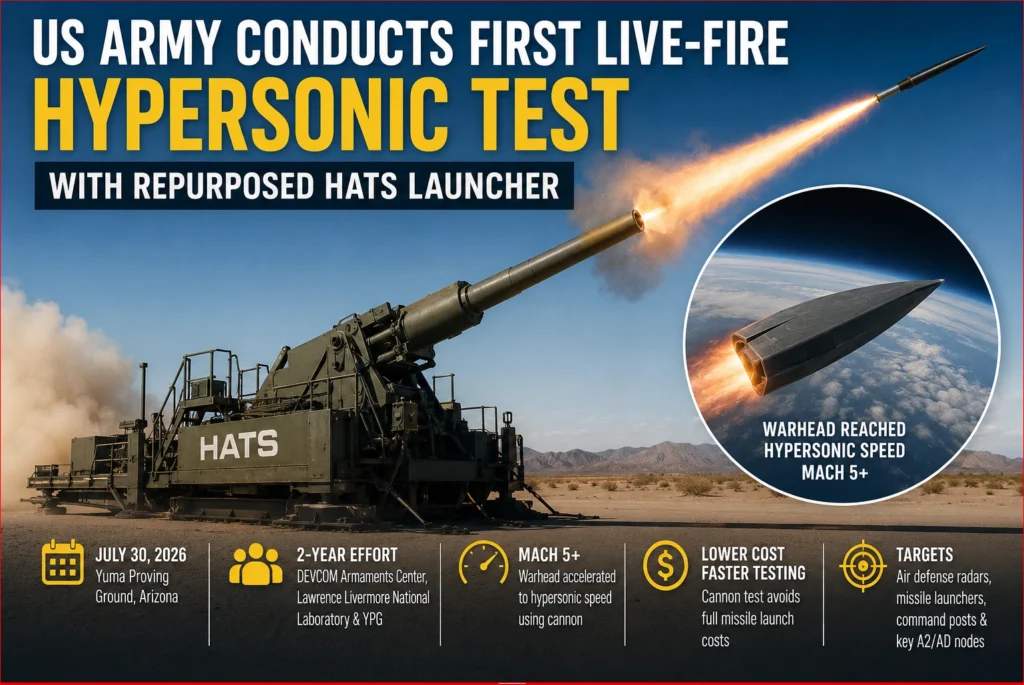
The U.S. Army has quietly turned a “cancelled” weapons program into one of its more resourceful engineering wins of the year. On July 30, 2026, at the Yuma Proving Ground in Arizona, the service completed the first full-scale live-fire test of a hypersonic warhead launched from a cannon-based test system and the gun used to do it has an interesting backstory of its own.
From Cancelled Supergun to Hypersonic Test Bed
The launcher behind this milestone is called the Heavy Artillery Test System, or HATS. It isn’t a brand-new piece of hardware. HATS is a repurposed version of the cannon originally built for the Army’s Strategic Long Range Cannon (SLRC) program, an ambitious effort first unveiled in 2019 to build a massive artillery piece capable of hitting targets more than 1,000 miles away using rocket-assisted, precision-guided projectiles.
The SLRC was meant to give ground forces a long-range strike option that didn’t depend on aircraft or expensive missiles. But the program ran into serious engineering hurdles around transport, targeting, barrel wear, and survivability, and its strategic justification weakened further after the U.S. withdrew from the Intermediate-Range Nuclear Forces Treaty in 2019. Congress pulled dedicated funding for the SLRC in its fiscal year 2022 appropriations act, and the giant cannon looked destined for storage.
Instead of scrapping the hardware, the Army found it a new job.
What Actually Happened at Yuma
Rather than firing a complete hypersonic missile an expensive, resource-intensive undertaking — engineers loaded the HATS cannon with a specially built Integrated Launch Package (ILP). This is a hardened test capsule designed to protect an experimental hypersonic warhead from the extreme acceleration, pressure, and shock generated inside a large-caliber gun barrel, which are very different stresses than a warhead experiences riding atop a rocket booster.
The effort was a two-year collaboration between the Army’s DEVCOM Armaments Center, Lawrence Livermore National Laboratory, and the Yuma Proving Ground test range. Specialists integrated the warhead into its protective launch package and fitted it with a DEVCOM-built electronic safe-and-arm fuze to prevent accidental detonation. Before any hardware was even built, the team ran extensive peer reviews to validate that a cannon-launched hypersonic test was safe to attempt.
The result: a warhead accelerated to hypersonic speed Mach 5 or greater — using a gun instead of a rocket, giving engineers real flight and impact data at a fraction of the usual cost.
Why This Matters
Hypersonic weapons testing is notoriously expensive. Traditional tests typically require launching an entire missile, complete with rocket boosters, guidance systems, and a disposable warhead, just to gather data on how the payload performs at the moment of impact. That makes iteration slow and costly.
By using a cannon to do the same job, the Army has found a way to evaluate terminal effects and payload survivability without burning through an entire missile system each time. Reports suggest the target set for this kind of testing includes systems relevant to countering integrated air defenses — things like air defense radars, surface-to-air missile launchers, command posts, logistics hubs, and long-range fires units, the kind of nodes that make up modern anti-access/area-denial (A2/AD) networks.
This isn’t the Army’s only hypersonic effort. Separately, the Army’s Long-Range Hypersonic Weapon (LRHW), officially named “Dark Eagle” in April 2025, is a mobile ground-launched hypersonic glide weapon designed to strike targets beyond 2,775 km at speeds above Mach 5. The Army and Navy completed a full end-to-end flight test of that system’s complete technology suite in December 2024. The HATS cannon test is a different, cheaper piece of the puzzle: a way to rapidly evaluate warhead and payload performance without needing a full missile flight every time.
The Bigger Picture
There’s something fitting about a cancelled artillery program finding a second life as critical infrastructure for the country’s hypersonic weapons push. Instead of writing off years of engineering investment when the SLRC lost its funding, the Army kept the launcher, repurposed it, and turned it into a tool that could actually accelerate a different, higher-priority program. It’s a reminder that in defense R&D, “cancelled” doesn’t always mean “wasted” — sometimes it just means “not finished being useful yet.”
FAQ
What is the HATS launcher?
HATS stands for Heavy Artillery Test System. It’s a large-caliber cannon originally built for the Army’s now-cancelled Strategic Long Range Cannon (SLRC) program, later repurposed as a low-cost platform for hypersonic weapons testing.
When and where did the test take place?
The live-fire test happened on July 30, 2026, at the Yuma Proving Ground in Arizona, a U.S. Army testing installation spanning more than 830,000 acres.
Who was involved in developing and running the test?
The test was a joint effort between the Army’s DEVCOM Armaments Center, Lawrence Livermore National Laboratory, and the Yuma Proving Ground test range, following a two-year development process.
Did the Army fire a complete hypersonic missile?
No. The Army fired only the warhead, packaged inside a hardened Integrated Launch Package (ILP), rather than launching a full hypersonic missile with its own rocket booster.
Why use a cannon instead of a missile for testing?
It’s significantly cheaper and faster. A cannon-based test avoids the cost of an entire rocket-propelled missile system, letting engineers repeatedly gather warhead performance and impact data at a fraction of the price.
What happened to the original Strategic Long Range Cannon program?
The SLRC aimed to build a supergun that could strike targets over 1,000 miles away. Congress ended its dedicated funding in the fiscal year 2022 appropriations act, cancelling the program before a full prototype demonstration.
Is this related to the Army’s “Dark Eagle” hypersonic missile?
They are related but separate efforts. Dark Eagle (LRHW) is the Army’s operational, mobile hypersonic glide missile system, tested in full in December 2024. The HATS cannon test is a cheaper, faster method for evaluating hypersonic warhead performance, supporting the broader hypersonic development effort.
What targets is this hypersonic technology meant to address?
Reported target sets include air defense radars, surface-to-air missile launchers, command posts, logistics centers, and long-range fires units key components of adversary anti-access/area-denial (A2/AD) networks.