

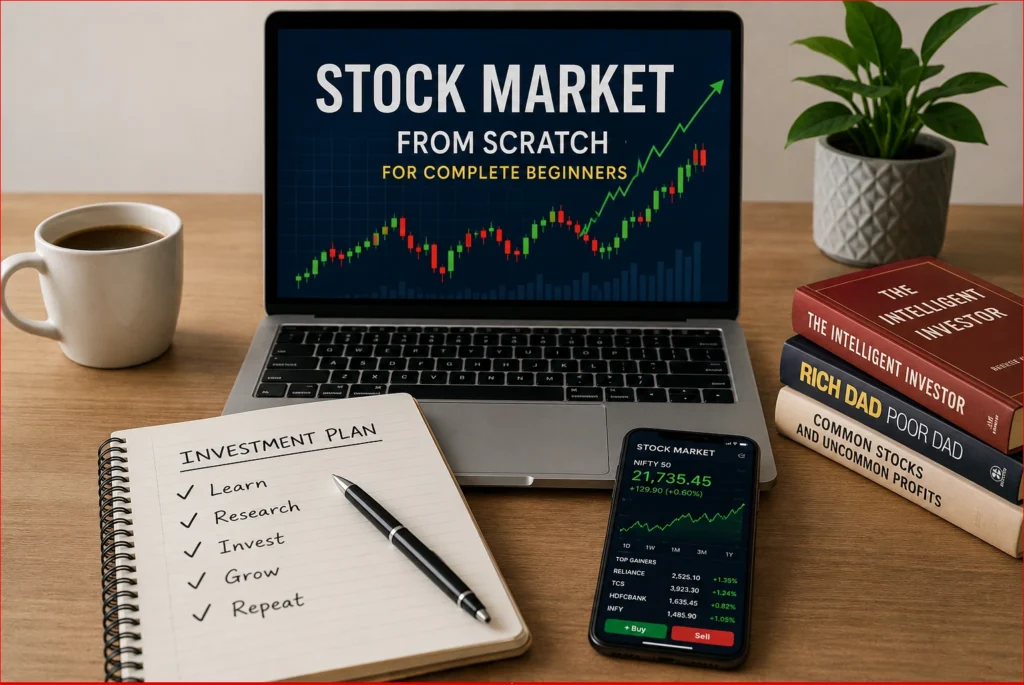
I still remember the first time someone told me to “just buy stocks.” I nodded like I understood, went home, opened a trading app, stared at a screen full of numbers going red and green, and closed it within five minutes. If that sounds like you, welcome — you’re in the right place. This is Stock Market From Scratch For Complete Beginners, written the way I wish someone had explained it to me: no jargon, no shortcuts, just the basics that actually matter.
What Is the Stock Market, Really?
Forget the Wall Street movies for a second. At its core, the stock market is just a marketplace — like a sabzi mandi, but instead of vegetables, people are buying and selling tiny pieces of companies.
When a company like Tata or Infosys wants to raise money to grow, it sells small ownership pieces called shares or stocks. When you buy one share, you technically own a tiny fraction of that company. If the company does well and grows, the value of your share usually goes up. If it struggles, the value can go down. That’s it. That’s the entire concept everyone makes sound complicated.
Why Do Stock Prices Move Up and Down?
This is where most beginners get confused, so let’s keep it simple. Stock prices move because of supply and demand. If more people want to buy a stock than sell it, the price rises. If more people want to sell than buy, the price falls.
But why do people suddenly want to buy or sell? Usually because of:
- Company performance — good quarterly results, new product launches, or strong leadership
- Economic news — interest rate changes, inflation data, government policies
- Global events — wars, oil prices, or major world news
- Investor emotions — fear and greed genuinely move markets more than logic does
Once you understand this, the market stops feeling random and starts feeling like a pattern you can learn to read.
The Basic Terms You Actually Need to Know
You don’t need to memorize fifty terms on day one. Just these will get you through your first few months:
Stock/Share – A unit of ownership in a company.
Stock Exchange – The platform where stocks are bought and sold (in India, that’s mainly the NSE and BSE).
Index – A basket of top stocks used to measure overall market performance. In India, think Nifty 50 and Sensex.
Demat Account – A digital account that holds your shares, just like a bank account holds your money.
Broker – The middleman (usually an app today, like Zerodha, Groww, or Upstox) that lets you actually buy and sell shares.
Portfolio – The collection of all the stocks and investments you currently own.
Dividend – A small portion of company profit that some companies share with shareholders regularly.
Once these words stop feeling foreign, half the intimidation of the stock market disappears.
How Do You Actually Start Investing?
Here’s the practical part nobody explains clearly enough.
Step 1: Open a Demat and Trading Account
You can’t buy stocks directly — you need an account with a registered broker. Most Indian apps let you open one in under 15 minutes using your PAN card and Aadhaar.
Step 2: Start With an Amount You Won’t Panic Over
Don’t put in your entire savings on day one. Start with an amount that, if lost, won’t affect your sleep. Many beginners start with just ₹500–₹1000 to get comfortable with how the process feels.
Step 3: Research Before You Buy
Never buy a stock just because a friend or a YouTube video told you to. Look at what the company does, whether it’s profitable, and whether you actually understand its business.
Step 4: Think Long-Term
The biggest mistake beginners make is checking prices every hour and panicking over small dips. Historically, the stock market rewards patience far more than it rewards quick trading.
Common Beginner Mistakes (I’ve Made Most of These)
- Investing money you need soon. Never invest your emergency fund or rent money.
- Following the crowd blindly. Just because a stock is trending doesn’t mean it’s a good buy.
- Trying to time the market perfectly. Even professionals fail at this consistently.
- Ignoring diversification. Don’t put all your money into one stock or one sector.
- Letting emotions drive decisions. Fear makes you sell too early; greed makes you buy too late.
A More Honest Way to Look at It
The stock market isn’t a lottery, and it isn’t a guaranteed ATM either. It’s a tool — one that, used with patience and basic knowledge, has historically helped ordinary people build wealth over years, not overnight. The goal isn’t to predict every up and down. The goal is to understand enough that you’re not scared, and disciplined enough that you don’t quit after your first red day.
Every experienced investor you admire today once stared at a trading app just like you’re doing right now, completely unsure of what any of it meant. The only real difference between them and a beginner is time, consistency, and a willingness to keep learning.