
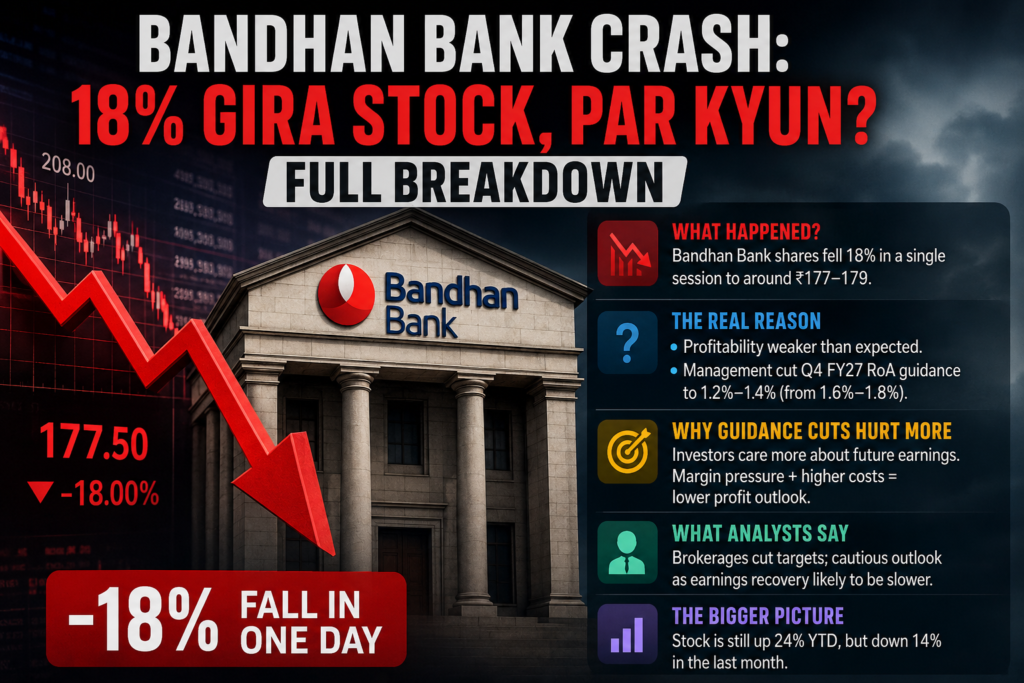
If you’ve been tracking the stock market this week, you’ve probably seen the headlines: Bandhan Bank shares took a massive hit on Wednesday, sliding as much as 18% in a single session. What makes this crash particularly puzzling for retail investors is that it wasn’t triggered by a scam, a scandal, or an outright loss. On paper, the bank’s business looked reasonably steady. So why did the market punish Bandhan Bank shares so brutally? Let’s break it down.
What Happened to Bandhan Bank Shares
Bandhan Bank shares tumbled sharply during Wednesday’s trading session, falling to a low of around ₹177–179 on the NSE and BSE, compared to the previous close near ₹208. This pushed the stock to its lowest level since April, and it now sits nearly 19% below its 52-week high of ₹220.70, which was touched just a week earlier on July 15.
The sell-off came a day after the bank announced its results for the April-to-June quarter of FY27, released after market hours on Tuesday. Trading volumes were unusually heavy, signalling that this wasn’t a handful of nervous investors — it was a broad, market-wide reaction to something specific in the results.
The Real Reason Behind the Bandhan Bank Stock Crash
Here’s the twist: Bandhan Bank’s quarter wasn’t a disaster. Net interest margins held reasonably stable at around 6.2%, and asset quality actually improved a little, with gross and net slippages ticking down and credit costs easing slightly compared to the previous quarter.
So what spooked investors? Two things, really.
First, profitability came in weaker than expected. Pre-provisioning operating profit dropped nearly 19% year-on-year, mainly because of higher operating expenses — think annual wage hikes, gratuity provisions, and heavier technology spending — combined with softer non-interest income.
Second, and more importantly, management didn’t sugarcoat what lies ahead. During the post-results call, the bank cut its own profitability targets, lowering its exit Return on Assets (RoA) guidance for Q4 FY27 to a range of 1.2–1.4%, down from the earlier 1.6–1.8%. That’s a meaningful downgrade, and markets tend to punish guidance cuts far more severely than they punish a single weak quarter.
Why Guidance Cuts Hit Harder Than Earnings Misses
This is the part that often confuses newer investors. A stock isn’t just priced on what a company earned last quarter — it’s priced on what investors expect it to earn in the future. When a management team openly tells the Street that margins will stay under pressure for the next couple of quarters, and that costs will remain elevated, it forces analysts to rework their entire earnings model for the year.
Bandhan Bank’s leadership attributed roughly 40 basis points of the guidance cut to margin pressure, and another 10 basis points to higher operating costs. They pointed to a mix of external headwinds too — elevated funding costs, geopolitical tensions in West Asia, volatile energy prices, unpredictable monsoons, and continued investment in technology. In other words, this isn’t a one-quarter blip; it’s a signal that the recovery investors were hoping for is going to take longer than expected.
What Analysts Are Saying Now
Unsurprisingly, brokerages have started revising their targets. Some, like Macquarie, have taken a notably cautious stance with lower price targets, while others remain more optimistic, pointing to the bank’s improving asset quality and manageable credit costs as reasons to stay patient. The broad theme across analyst notes is one of caution: earnings recovery is likely to be slower than earlier anticipated, with margin expansion and operating leverage benefits getting pushed further out.
The Bigger Picture for Investors
Zooming out, Bandhan Bank shares have actually delivered over 24% returns on a year-to-date basis, even after this crash — a reminder that a single bad session doesn’t erase the bigger trend. That said, the stock has lost around 14% in just the past month, which shows how quickly sentiment can flip when guidance disappoints.
For existing shareholders, this is a moment to separate noise from substance: the core business isn’t falling apart, but near-term profitability will likely stay under pressure. For prospective investors, it’s worth watching the next couple of quarters closely to see if margin pressures ease as management expects.
This article is for informational purposes only and should not be treated as investment advice. Please consult a qualified financial advisor before making any investment decisions.