
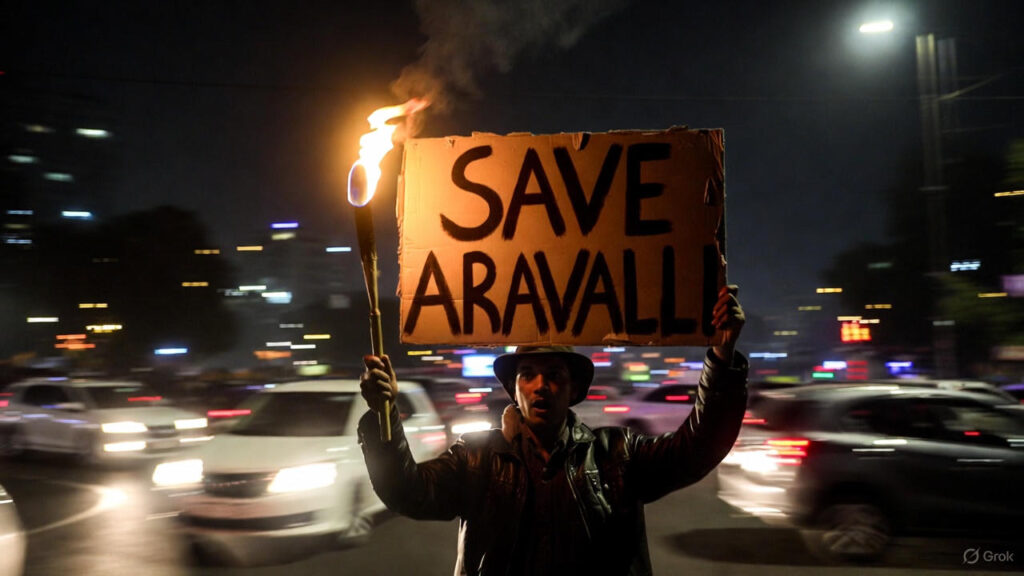
The Aravalli Row: Politics, Data Disputes and the Future of India’s Oldest Mountains
In one of the latest and most intense political battles over environmental policy in India, the controversy around the Aravalli mountain range has escalated into a high-profile clash between Union Environment Minister Bhupender Yadav and senior Congress leader Jairam Ramesh. What began as a technical debate over definitions and data has now spiralled into accusations, counter-accusations and deep mistrust — with significant implications for the ecology of one of India’s most ancient geological formations.
The Aravalli Range, stretching from Gujarat through Rajasthan to Haryana and Delhi, is among the oldest mountain systems in the world. Its hills, forests and rocky outcrops play a crucial role in groundwater recharge, biodiversity support, climate stability and desertification prevention. Over decades, it has faced pressures from mining, urban expansion and illegal resource extraction — making its protection a matter of national ecological importance.
Redefining “Hills” — A Technical Trigger with Big Consequences
The controversy erupted after the government and the Supreme Court approved a uniform definition of what constitutes an “Aravalli Hill” and “Aravalli Range”. Under this approach, a landform qualifies as a hill only if it has an elevation of 100 metres above the surrounding local terrain, and at least two such hills within proximity are needed to call it a range. Critics argue that this threshold — while seemingly technical — effectively excludes a large majority of the Aravallis from formal ecological protection, especially the low slopes and ridges that are vital for water recharge and wildlife corridors.
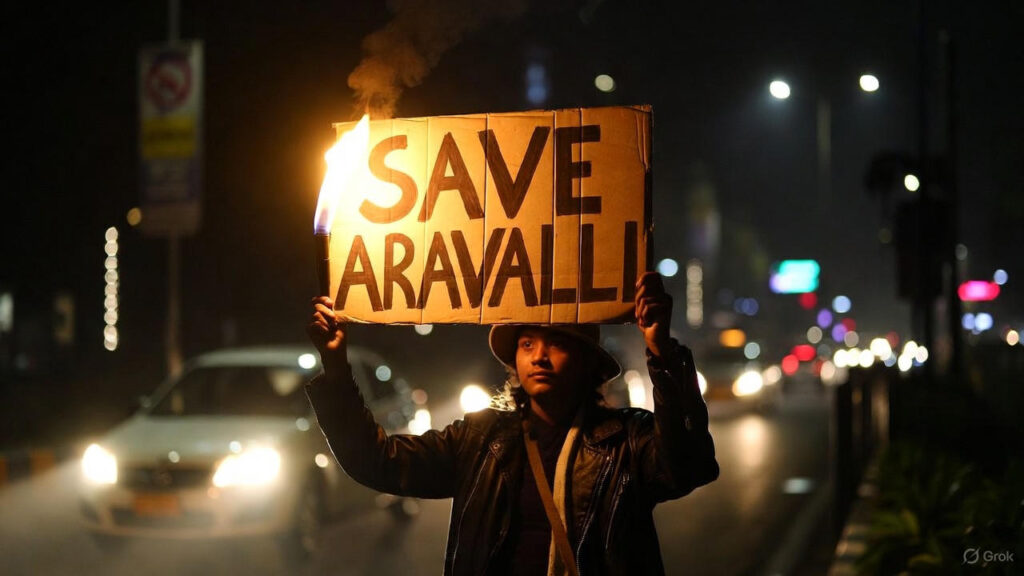
It’s in this context that the political sparring between Yadav and Ramesh has unfolded.
Bhupender Yadav’s Position: Clarity, Sustainable Mining and No New Leases
Union Environment Minister Bhupender Yadav has defended the government’s move as a balanced effort to both protect the Aravallis and allow regulated, sustainable mining where feasible. He has repeatedly said the new definition applies only for the purpose of mining regulation, not to dismantle ecological protections. According to the minister, only around 277.89 square kilometres — or roughly 0.19% of the total identified Aravalli landscape — would be open to mining. He adds that no new mining leases will be granted until comprehensive scientific studies are completed, and that protections remain strong across the vast majority of the range.
Yadav has also accused the opposition of spreading “misinformation” and “lies” about the situation, asserting that claims of a weakened environmental regime are simply inaccurate. To him, the redefinition brings much-needed clarity and legal uniformity to a field long mired in conflicting interpretations.
Jairam Ramesh’s Rebuttal: Data Manipulation, Forest Survey and Distrust
On the other side, Jairam Ramesh — a former environment minister with deep legislative experience — has launched a blistering challenge to Yadav’s narrative. Ramesh accuses the environment ministry of misleading the public, manipulating Forest Survey of India (FSI) data and even “muzzling” independent forest assessments to fit the government’s preferred definition. He stresses that the FSI is currently under additional charge by a ministry official, which he claims undermines its institutional autonomy.
Ramesh argues that the government’s figure of 0.19% is deceptive, based on an inflated denominator — the total land area of 34 districts — rather than the actual Aravalli terrain. He asserts that if the real hills’ area is used as the baseline, the proportion of land effectively “exposed” to mining and development could be much larger. Moreover, he has challenged the government to release the raw elevation data and make FSI conduct a formal, transparent study across the key 15 districts of Rajasthan.
Beyond technical detail, Ramesh frames his argument in moral and environmental terms: the Aravallis are a natural heritage that must be protected fully, not reshaped by definitions that could serve political or commercial interests. He has also signalled plans to approach the Supreme Court again, underlining that the fight is far from over.
Why This Matters: Ecology, Politics and Public Trust
The Aravalli debate underscores a deeper truth about environmental governance in India: scientific data, legal definitions and political communication are all deeply intertwined. When experts, politicians and the public disagree on something as fundamental as how to measure a hill, policy paralysis and public suspicion often follow. Ecologists warn that excluding lower elevations from protection — no matter how technically justified — could accelerate land degradation, water scarcity and habitat loss. Meanwhile, political rhetoric fuels public distrust on both sides.
In the end, theAravalli row is about more than just mining or forest data — it’s about how India chooses to balance development and environmental stewardship in an era of climate unpredictability. How this dispute resolves — legally, politically and scientifically — will shape not just the future of a mountain range, but also the credibility of environmental governance in the country.