
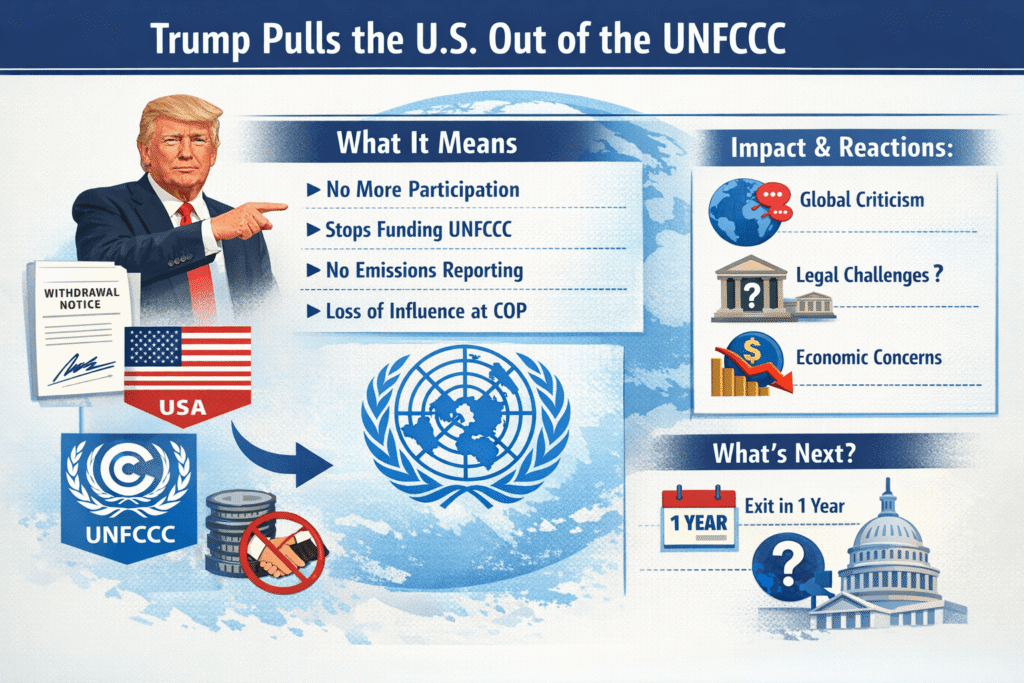
On January 7–8, 2026, the Trump administration announced that the United States will withdraw from the United Nations Framework Convention on Climate Change (UNFCCC)—the central global treaty on climate change that nearly every country in the world has joined. This is a historic and controversial move with major domestic and international implications.
What Is the UNFCCC?
The UN Framework Convention on Climate Change (UNFCCC) is the foundational global treaty on climate change. It was negotiated during the 1992 Earth Summit in Rio de Janeiro and has almost all nations as “Parties.” It sets basic rules for how countries should monitor, report, and reduce greenhouse gas emissions and prepare for climate impacts.
Under the treaty, countries meet every year at the Conference of the Parties (COP) to negotiate climate goals, review emissions data, and cooperate on reducing global warming. The Paris Agreement, adopted in 2015, sits under the UNFCCC and translates its general principles into concrete national targets.
What Trump’s Announcement Actually Means
President Donald Trump issued a presidential memorandum directing the U.S. government to begin withdrawal from the UNFCCC and cease participation and funding to it and dozens of other international bodies deemed “contrary to U.S. interests.” The memo lists withdrawal from 66 organizations, including 31 U.N. entities like the UNFCCC and the Intergovernmental Panel on Climate Change (IPCC).
Immediate Effects
- No More Participation as a Party
- The U.S. will no longer be a formal “Party” to the UNFCCC treaty. This means it won’t be involved in negotiating climate rules, agreements, or global strategy discussions.
- No Obligations or Reporting
- The U.S. will not be formally required to report greenhouse gas emissions through the UNFCCC system or follow review procedures that track global progress.
- No Leadership Role at COP
- U.S. government officials won’t be part of formal decision-making at international climate talks (COP) as a Party, potentially attending only as observers with limited influence.
- Withdrawal Takes Time
- According to treaty rules and past practice, withdrawal usually takes about one year after formal notice. So full exit might not be immediate.
Why This Is a Bigger Step Than Leaving the Paris Agreement
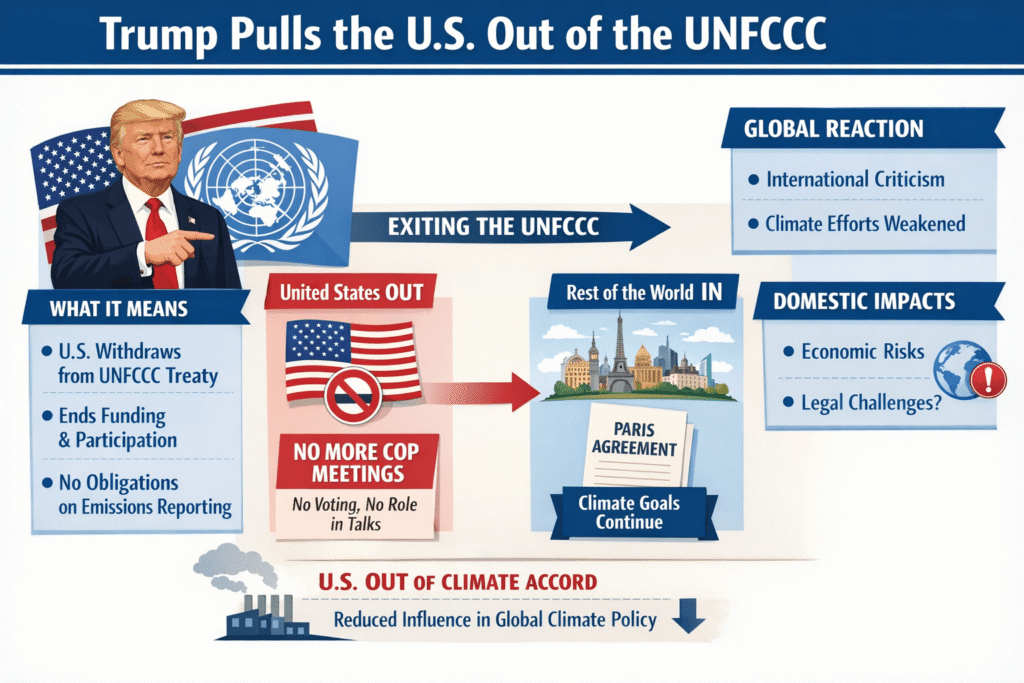
The Trump administration already withdrew the U.S. from the Paris Agreement, another key climate pact under the UNFCCC. But exiting the UNFCCC itself goes much further: it removes the U.S. from the global architecture of climate diplomacy, not just the specific Paris climate targets. Grist
Think of the UNFCCC as the “framework” in which all global negotiations happen, and the Paris Agreement as one “deal made inside” that framework. Leaving the framework means the U.S. is not part of the climate “club” at all anymore. Grist
International and Domestic Reactions
Global Reaction
- Widespread international criticism has followed. World leaders and climate officials have called the move “damaging” and a reversal of decades of cooperation. Europeans and many developing nations stressed that the U.S. pulling out weakens global climate efforts.
- The UN climate chief called the decision a “colossal own goal,” warning it could harm U.S. economic and environmental interests.
Legal and Political Questions
Some legal experts argue that the U.S. Senate must approve withdrawal from a treaty the Senate ratified in 1992. If that’s true, the executive action might be legally contested in U.S. courts.
Others suggest a future administration might re-enter the treaty—but whether this requires a new Senate ratification or not is debated.
Domestic Policy Impacts
- Withdrawing also affects U.S. influence over global clean energy markets, standards, and economic policy tied to climate action.
- Critics say the U.S. risks losing economic opportunities in the global shift to green technology and clean energy.
Broader Implications for Climate Action
Experts warn that one major economy not participating in global climate governance could slow international progress, reduce cooperation, and embolden other countries to weaken their commitments.
However, the U.S. remains a major emitter of greenhouse gases. Absent federal involvement, state governments, cities, and companies may still pursue climate policies domestically. This means the U.S. might still have some influence indirectly—but without a formal seat “at the table” in global negotiation