
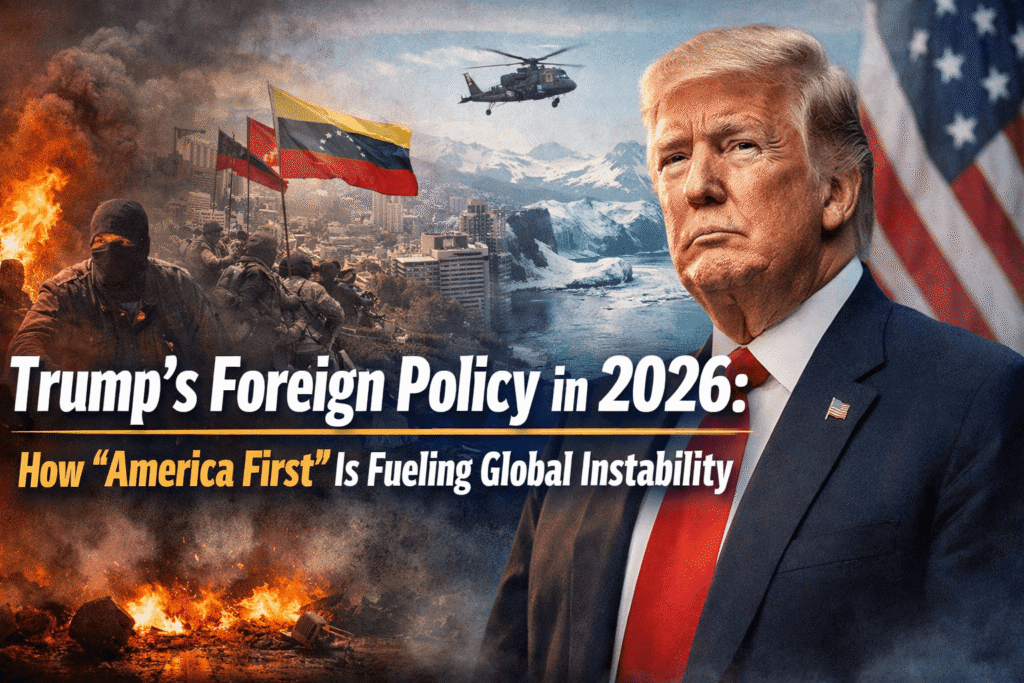
Trump’s Foreign Policy in 2026: There’s a restless, uneasy feeling hanging over world politics these days — as if history itself is holding its breath. In every continent from Latin America to the Arctic, decisions made in Washington are reshaping the global order in ways that feel unpredictable, aggressive, and deeply consequential. What’s clear now is that Donald Trump’s America First foreign policy isn’t just a slogan — it has become a powerful force driving U.S. engagement abroad, with profound costs and worldwide repercussions.
In the early weeks of 2026, the tension between the United States and Iran reached fever pitch. Fears of a U.S. military strike on Tehran sparked anxious debates across the Middle East and beyond. Arab governments and diplomats worked urgently behind closed doors to dial down the threat of conflict, while military forces moved into position and communication channels stayed open just enough to prevent an outbreak of violence. Ultimately, Trump declared that “the killing has stopped,” but thousands have reportedly perished in brutal crackdowns on anti-government protests, and the specter of instability still looms large.
At the same time, Trump’s dramatic Venezuela intervention — where U.S. forces captured President Nicolás Maduro — marked a seismic shift from his previous anti-intervention rhetoric. This move was justified as necessary for combatting drug trafficking and securing energy resources, yet it also signaled a new and more assertive U.S. approach in Latin America. Critics argue it reflects not just power but a reimagined strategy informally dubbed the Donroe Doctrine — a modern twist on old U.S. influence aimed at cementing dominance in the Western Hemisphere.
As if Middle Eastern tensions and Latin American upheaval weren’t dramatic enough, the world’s attention has also turned northward to Greenland. Trump has repeatedly insisted that “the U.S. needs Greenland” for national security, sparking fears of unilateral action to acquire this vast, strategically located Arctic territory. European leaders — especially from Denmark and NATO allies — have publicly rejected the idea, warning that any attempt to seize control could fracture alliances and reignite geopolitical rivalries.
This push toward Greenland represents more than just territorial ambition. It underscores a broader climate of global instability where traditional diplomatic norms are sidelined for bold, headline-grabbing actions. Trump’s aggressive rhetoric — including blurbs about bypassing international law and prioritizing “America First” dominance — has triggered widespread concern among global leaders and ordinary citizens alike.
Meanwhile, public opinion in the United States mirrors this unease. Recent polls show a majority of Americans now oppose further U.S. military involvement abroad, especially in conflicts like Iran — and many even question whether America should pursue Greenland or other arenas with military force.
What’s striking about this era is how Trump’s unilateral style — fueled by spectacle, short-term victories, and unpredictable moves — has become the method in practice. Some compare it to Richard Nixon’s “madman theory,” but in Trump’s case, it feels less like strategic calculus and more like reactive geopolitics without a defined endgame. Whether it’s tension with Iran, the upheaval in Venezuela, or the Arctic ambitions in Greenland, the world today is confronting the consequences of a foreign policy driven by personality, momentum, and brinkmanship
Disclaimer:This article is a creative interpretation based on publicly available editorial content and global news reports. It reflects an analytical perspective and should not be taken as an official news account.