
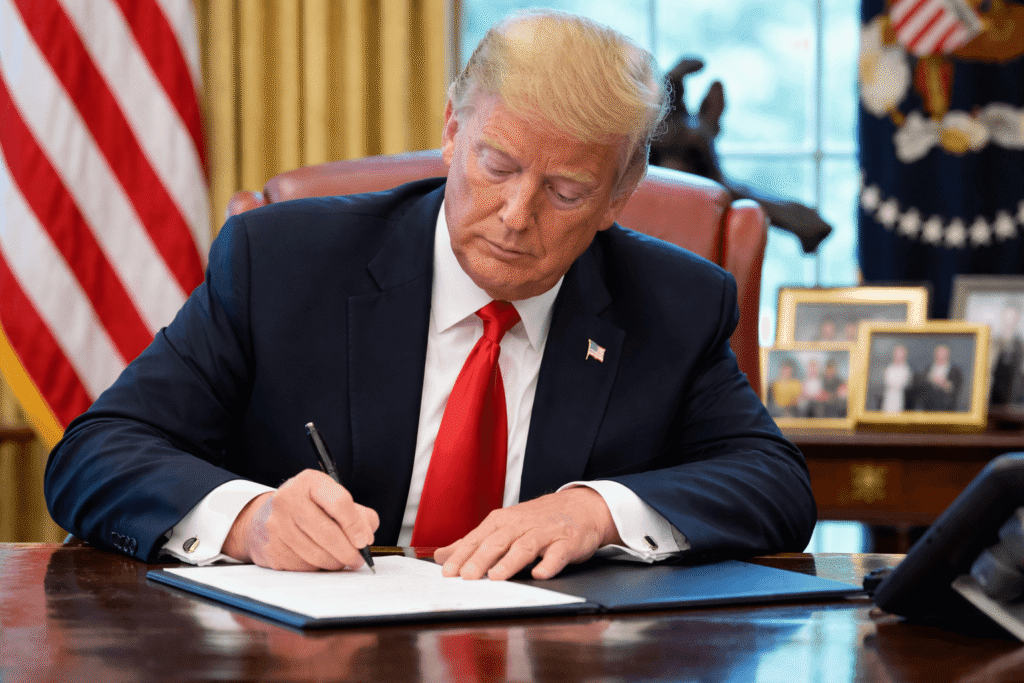
U.S. President Donald Trump has signed a sweeping executive order aimed at shielding billions of dollars in Venezuelan oil revenue held in U.S. Treasury accounts from seizure by courts or private claimants, marking a significant escalation in Washington’s efforts to manage the future of Venezuela’s oil assets amid ongoing political upheaval in the South American nation.
The order, issued on January 9 under the authority of the International Emergency Economic Powers Act and the National Emergencies Act, prohibits any attachment, judgment, decree, lien, execution, garnishment, or other judicial process against what the government describes as “Foreign Government Deposit Funds” — basically, proceeds from the sale of Venezuelan crude and related products that are held in U.S. accounts.
According to the White House fact sheet, Trump declared that allowing these funds to be seized by judgment creditors or through court action would “materially harm the national security and foreign policy of the United States.” The administration argues that maintaining control over these revenues is essential to advancing broader U.S. objectives, including efforts to stabilize Venezuela, counter drug trafficking, curb illegal immigration, and diminish the influence of hostile foreign actors in the Western Hemisphere.
What the Order Does
Under the executive order, the Venezuelan funds in question — although technically sovereign assets of the Venezuelan government — are to be treated as being held in a custodial capacity by the U.S. Treasury. The order makes clear that such assets may not be subject to any form of judicial seizure unless specifically authorized by new regulations issued under the executive order.
In essence, any attempt by creditors — including major international companies that have long pursued claims against Venezuela — to attach or access these revenues will be deemed null and void. This could have far-reaching implications for lawsuits by companies such as ExxonMobil and ConocoPhillips, which have sought compensation for nationalized assets in Venezuela dating back nearly two decades.
The White House emphasized that this executive action does not transform the funds into U.S. property, but rather preserves them as sovereign Venezuelan assets held in U.S. custody pending “sovereign disposition” in accordance with U.S. foreign policy objectives.
Context: Venezuela and U.S. Policy
The move comes in the midst of dramatic developments in Venezuela, including the capture of long-time leader Nicolás Maduro by U.S. forces earlier this month — a controversial and unprecedented operation that has drawn sharp international criticism. In the aftermath, the Trump administration has stepped up efforts to assert influence over the country’s vast oil reserves, which represent some of the largest in the world.
Trump and senior U.S. officials have said they intend to market Venezuelan oil and use the proceeds for strategic goals, including stabilizing the Venezuelan economy and benefitting both Venezuelan and American interests. The administration also reportedly seeks significant investment — potentially as much as $100 billion — from U.S. oil companies to rebuild Venezuela’s decrepit oil industry, which has suffered years of underinvestment and mismanagement.
Domestic and Legal Reactions
Legal scholars and critics have raised questions about the scope of presidential authority to effectively insulate foreign sovereign assets from private claims. Some argue that the executive branch’s control over the disposition of these funds may push the boundaries of federal law, particularly regarding how such assets are classified and whether they should be treated as Venezuelan property or as revenues accessible under U.S. law.
For years, Venezuela has grappled with legal judgments from international and U.S. courts involving claims by foreign companies seeking damages for expropriated assets. By shielding oil revenues from attachment, the Trump administration is essentially prioritizing geopolitical and strategic goals over long–standing commercial and legal interests, with potential consequences for U.S. perceptions of sovereign immunity and creditors’ rights.
Supporters of the White House’s position argue that the extraordinary conditions in Venezuela — including economic collapse, political turmoil, and threats posed by criminal networks — justify strong executive action to preserve leverage over the country’s energy wealth. They say that without control over oil revenues, U.S. influence in the region would be weakened and hostile actors could exploit financial openings.
International Response and Wider Implications
International reactions have been mixed, with some governments and analysts warning that the U.S. move could set a troubling precedent in international law regarding the treatment of sovereign assets. Critics in Caracas and other capitals have condemned the action as further evidence of U.S. overreach into the internal affairs of another sovereign state.
The broader geopolitical ramifications may unfold over months to come, especially as Venezuela’s interim authorities negotiate oil deals and potentially open the door to renewed engagement with foreign investors. How the U.S. manages these funds — and whether courts challenge the executive order — will likely become a central issue in the evolving crisis.