
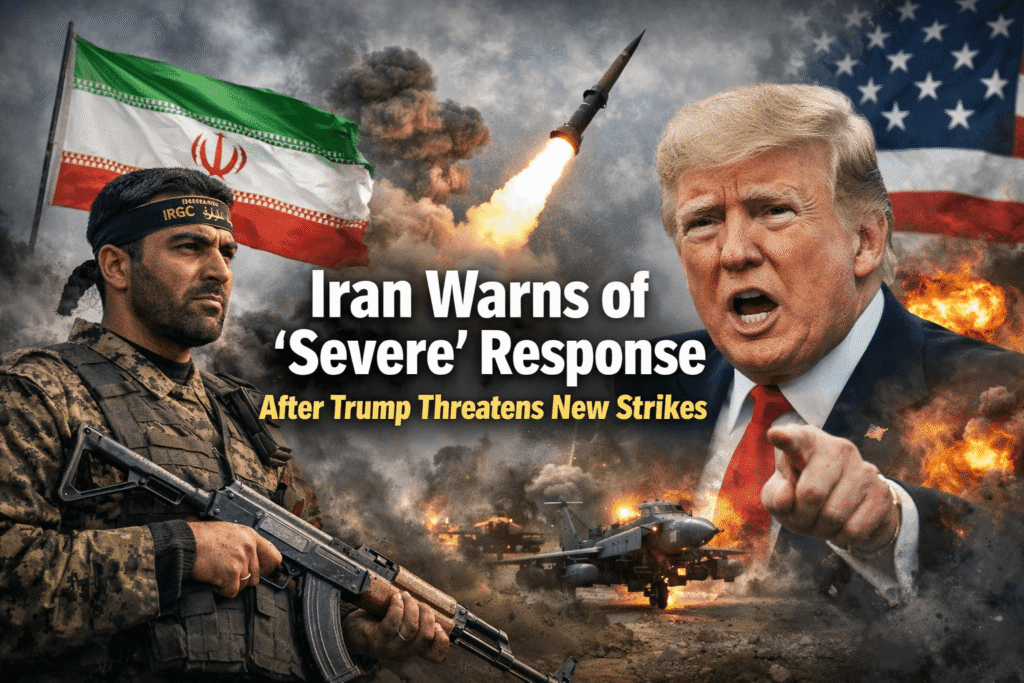
Tensions between the United States and Iran have once again reached a boiling point after former U.S. President Donald Trump threatened new strikes against Tehran. In response, Iranian officials have issued a stern warning, promising a “severe, immediate, and regret-inducing” reaction to any act of aggression. The exchange marks a dangerous escalation in an already volatile Middle East, rekindling fears of another cycle of confrontation between Washington and Tehran.
The warning came after Trump, speaking alongside Israeli Prime Minister Benjamin Netanyahu at his Mar-a-Lago estate in Florida, said that the United States could consider “knocking Iran down” if the country resumed its nuclear or ballistic missile programs. Trump’s comments came amid growing concern in Washington and Tel Aviv that Iran might be rebuilding parts of its nuclear infrastructure damaged during past military strikes.
Iranian President Masoud Pezeshkian swiftly condemned Trump’s remarks, calling them “reckless and provocative.” In a statement posted on social media platform X, Pezeshkian vowed that Iran would “defend its sovereignty and national interests with full force.” He said any aggression would be met with “a firm, destructive, and unforgettable response” that would make aggressors regret their actions.
Senior Iranian officials echoed his sentiments. Ali Shamkhani, a key adviser to Supreme Leader Ayatollah Ali Khamenei, warned that Iran’s response to a potential U.S. or Israeli attack would be “unimaginable in scale and scope.” According to Shamkhani, Iran’s defense system has been placed on high alert, with strategic responses already prepared for multiple scenarios. “If they strike, they will face consequences that cannot be contained,” he said.
The renewed war of words follows a bloody summer that saw unprecedented clashes between Iran and Israel. In June 2025, a U.S.-backed Israeli air campaign targeted Iranian nuclear and military facilities across several provinces. Iran retaliated by launching hundreds of missiles and drones toward Israel and U.S. bases in the Persian Gulf. The twelve-day conflict killed hundreds on both sides and devastated infrastructure across the region before a shaky ceasefire was brokered through international mediation.
Since then, regional powers have been urging restraint, fearing that another miscalculation could ignite a full-scale war. Russia, China, and the European Union have called for diplomatic engagement, while the United Nations urged all parties to avoid “provocative statements that risk destabilizing an already fragile peace.” The UN Secretary-General appealed to both Tehran and Washington to return to dialogue rather than confrontation.
Despite these appeals, analysts say the situation remains dangerously unstable. Trump’s latest comments appear designed to reassure Israel of continued U.S. backing, but they have also emboldened hardliners in Tehran. Political analysts note that the rhetoric benefits both sides domestically — Trump’s tough stance appeals to his conservative base in the United States, while Iranian leaders use it to rally nationalist support and distract from economic troubles at home.
Iran maintains that its nuclear program is entirely peaceful, aimed at energy production and medical research. It has consistently denied seeking to build nuclear weapons. However, Western intelligence agencies claim Tehran has preserved much of the knowledge and materials necessary to restart weaponization activities quickly if it chooses to do so. The 2015 nuclear agreement, known as the JCPOA, collapsed after Trump withdrew the U.S. from it in 2018 and re-imposed sanctions. Efforts to revive the deal under the Biden administration stalled amid mutual distrust and political opposition.
In Tehran, state media broadcast Trump’s remarks repeatedly, framing them as proof of continued American hostility. Iranian commentators accused Washington of trying to provoke Iran into overreacting, thereby justifying future military action. “They are testing our patience,” one editorial declared, “but Iran will choose the time and place of its response.”
Experts warn that even a minor skirmish could have far-reaching consequences. The Strait of Hormuz — through which nearly a fifth of the world’s oil supply passes — remains a potential flashpoint. Any confrontation there could disrupt global energy markets, spike oil prices, and threaten international shipping. Meanwhile, U.S. forces in Iraq, Syria, and the Gulf states remain vulnerable to Iranian-backed militias who have vowed to retaliate if Iran itself is attacked.
For now, both sides appear locked in a tense standoff. American officials have not confirmed whether any military action is imminent, but the Pentagon has reportedly increased surveillance flights near Iranian airspace. Iranian forces, in turn, have conducted nationwide air defense drills, signaling readiness for any possible strike.
Diplomacy may yet provide a way out, but prospects appear dim. “Neither side wants to appear weak,” said regional security expert Dr. Leila Farzan. “But the danger is that pride and politics may lead to a clash that neither truly intends.”
As the new year approaches, the Middle East stands on edge once again — with the world watching closely to see whether words of war turn into acts of violence.