
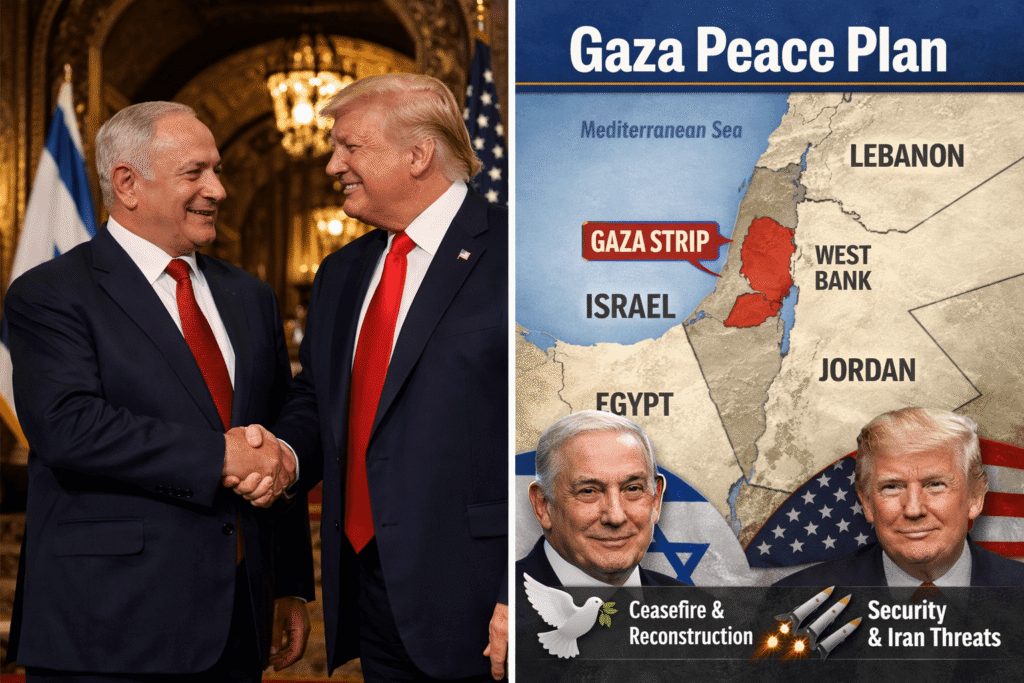
Israeli Prime Minister Benjamin Netanyahu is set to meet former U.S. President and current presidential candidate Donald Trump on December 29, 2025, in the United States. The meeting, titled Netanyahu to Meet Trump in the U.S. on December 29, will reportedly take place at Mar-a-Lago, Trump’s private resort in Florida. The two leaders are expected to discuss the next phase of the Gaza peace plan, regional stability, and broader security issues amid ongoing tensions in the Middle East.
The meeting comes at a crucial time, as Israel and Hamas continue to navigate a fragile ceasefire. According to Israeli and U.S. officials, both leaders aim to review progress on the post-war Gaza framework, focusing on reconstruction, disarmament, and international peacekeeping arrangements.
This will be Netanyahu’s fifth meeting with Trump this year, underlining the strong — yet occasionally strained — relationship between Israel and Trump’s political circle. Despite differences on timing and strategy, both share an interest in advancing a stable, U.S.-backed peace structure in the region.
Key Agendas of the Meeting
1. Gaza Peace Plan – Phase Two
Following the partial ceasefire achieved in October through Trump’s diplomatic intervention, the next step involves implementing a sustainable governance and security mechanism in Gaza.
Trump’s 20-point plan, first unveiled in early December, outlines a roadmap for lasting peace, emphasizing demilitarization, humanitarian aid, and an interim international administration to stabilize Gaza. Netanyahu’s participation in this plan is crucial, though he has faced domestic pressure from both hawks and moderates in Israel.
The December 29 meeting is expected to address several unresolved issues — including ceasefire violations, Hamas’s political future, and the role of regional partners such as Egypt, Jordan, and Saudi Arabia. Analysts say the outcome could shape the geopolitical balance in the Middle East for years to come.
2. Regional Security and the Iran Question
Another major point on the agenda will be Iran’s growing influence and its nuclear and missile capabilities. Israel has expressed alarm over Iran’s recent defense expansion and potential nuclear advancements. Netanyahu is expected to press Trump for firmer support — possibly including new sanctions or covert cooperation.
Trump, on the other hand, has indicated that while he supports Israel’s security needs, he also wants to avoid escalation that could draw the U.S. into another Middle Eastern conflict. This difference in approach may define the tone of their discussions, especially regarding Lebanon, Syria, and Yemen, where Iranian-backed militias remain active.
3. Political and Strategic Alliance
Beyond the Gaza and Iran issues, this meeting will reaffirm the long-standing strategic alliance between the United States and Israel. Trump has consistently branded himself as a strong supporter of Israel — a stance that appeals to both Jewish and evangelical Christian voters in the U.S.
During his stay, Netanyahu is also expected to meet American Jewish community leaders and Christian evangelical figures, key allies of Israel’s policies in Washington. These meetings will help strengthen political and moral support for Israel’s ongoing operations and its broader regional strategy.
Points of Tension and Potential Disagreements
Although Trump and Netanyahu have shared a close personal and political bond, their recent exchanges suggest emerging differences in diplomatic tone and tactical priorities.
Trump has reportedly advised a more “balanced” approach to avoid global backlash over the Gaza operations, while Netanyahu continues to favor security-first, hardline measures against Hamas and Iran. These contrasts may surface during the meeting, particularly on how to sustain the ceasefire without compromising Israel’s defensive objectives.
Such disagreements are not new — even during Trump’s presidency, both leaders occasionally diverged on timing and communication strategies related to Iran, Jerusalem’s status, and settlement expansion.
Global and Humanitarian Context
The humanitarian crisis in Gaza remains dire. Despite ceasefire talks, thousands of civilians are still displaced, facing shortages of water, medical supplies, and shelter. International organizations have urged Israel and its allies, including the U.S., to prioritize humanitarian relief alongside security discussions.
Observers expect the Netanyahu–Trump meeting to touch upon humanitarian corridors, reconstruction aid, and international NGO coordination, especially under the new peace framework being drafted by Washington.
Summary and Outlook
- Date of Meeting: December 29, 2025
- Venue: Mar-a-Lago, Florida
- Main Focus: Advancing Gaza peace plan, discussing Iran and regional stability
- Other Issues: U.S.-Israel political cooperation, humanitarian aid, and diplomatic strategy
The meeting marks a critical juncture for Middle Eastern diplomacy. Both Netanyahu and Trump aim to project strength and leadership at home while balancing the expectations of allies and critics abroad.
If successful, the talks could redefine U.S.–Israeli coordination and possibly shape the next phase of Middle East peace efforts. However, if disagreements persist, the world could see renewed volatility in Gaza and heightened regional tensions entering 2026.