
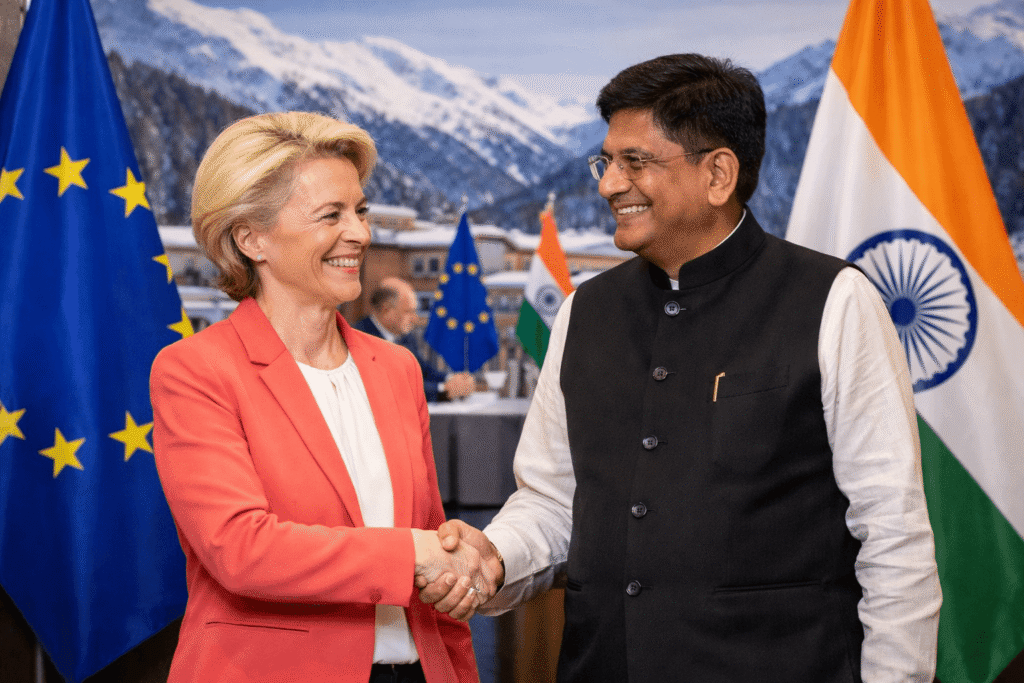
India-EU Trade Deal: In a move that could redefine global trade and economic diplomacy, the European Union (EU) and India are on the brink of finalizing a historic trade agreement — one being celebrated as the mother of all trade deals. The long-awaited India-EU trade deal is expected to open up a market of two billion people and reshape international commerce for decades to come.
At the World Economic Forum in Davos 2026, European Commission President Ursula von der Leyen expressed optimism about the upcoming pact, describing it as a turning point for both sides. “Right after Davos, next weekend, I will travel to India. There’s still work to do, but we are on the cusp of a historic trade agreement,” she said. “Some call it the mother of all deals — one that would create a market representing nearly a quarter of global GDP and give Europe a first mover advantage.”
A Deal Decades in the Making
The EU-India free trade agreement (FTA) has been years in the making. Negotiations first began in 2007 but were suspended in 2013 due to disagreements on tariffs and market access. Talks were finally relaunched in 2022, and now, in 2026, both sides seem closer than ever to sealing the deal.
India’s Commerce Minister Piyush Goyal recently called the upcoming pact “comprehensive and balanced,” assuring that it will protect domestic interests while deepening access to European markets. The trade agreement, expected to be signed on January 26, coinciding with India’s Republic Day 2026, could become one of the most significant milestones in India’s trade history.
Strengthening Global Economic Ties
The timing of this agreement is no coincidence. With the US-India trade deal still uncertain and the United States threatening higher tariffs on European Union goods, both New Delhi and Brussels see an opportunity to strengthen their strategic partnership. The move is widely seen as a response to shifting global power dynamics and growing trade protectionism.
Von der Leyen emphasized that Europe wants to partner with the growth centers of the future. “Europe will always choose the world — and the world is ready to choose Europe,” she said, underscoring her vision for a more open, cooperative global economy.
Symbolism and Strategic Importance
Adding weight to the occasion, both Ursula von der Leyen and European Council President Antonio Luís Santos da Costa will attend India’s Republic Day celebrations as chief guests. The two leaders will also co-chair the 16th India-EU Summit on January 27 — a meeting expected to officially mark the beginning of a new EU-India partnership for trade, innovation, and sustainability.
For both India and the European Union, this is more than a trade deal — it’s a shared statement of intent. It signals confidence, mutual trust, and a collective push toward a more balanced and inclusive international order. As the world watches, the India-EU trade deal could well become the blueprint for future alliances in a rapidly changing global trade landscape.
Disclaimer: This article is based on official statements and public reports. It is intended for informational purposes only and does not represent any official policy or government confirmation.