
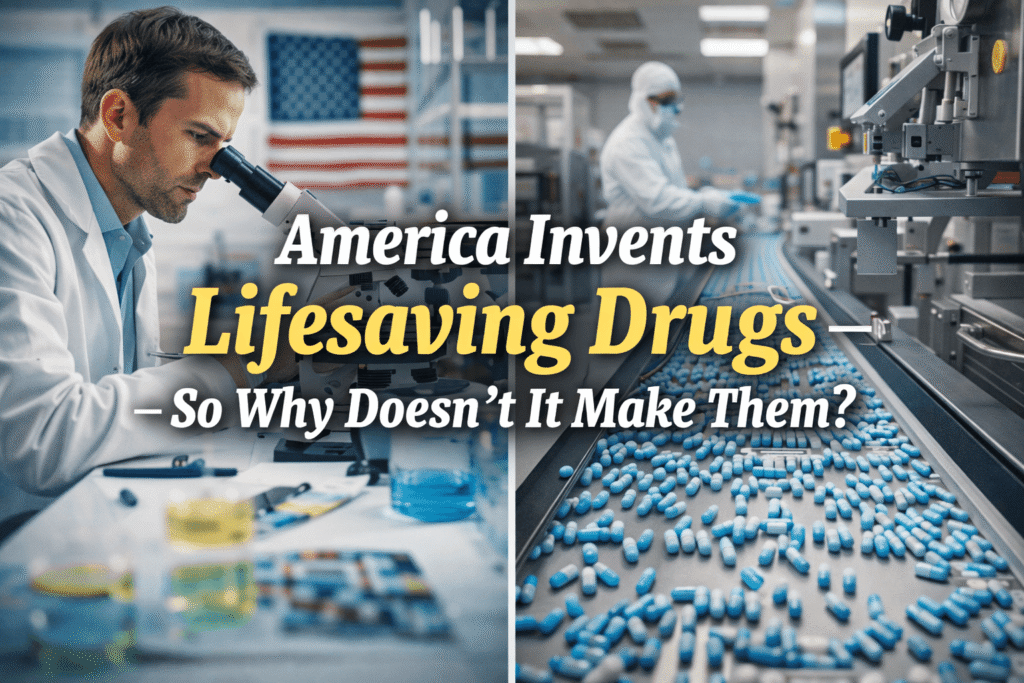
The United States is the world’s leader in creating new medicines. American scientists and companies design breakthrough treatments for cancer, heart disease, and infections. But here’s the surprising truth: most of those drugs aren’t actually made in America.
Instead, they’re produced in factories overseas — mainly in India and China. That means the country that invents the drugs often has to import them, even when millions of American patients depend on them every day.
Innovation at Home, Manufacturing Abroad
American labs develop most of the world’s new drugs. But once those drugs lose their patents and become generics — cheaper versions sold after the original brand’s patent expires — the picture changes completely.
Generics now make up around 90% of all prescriptions filled in the U.S., but the majority come from factories abroad. Even the raw materials and chemical ingredients for many medicines are imported. Some critical ingredients come almost entirely from China.
So, while the brainpower and discovery happen in the U.S., the physical making of pills and injections often takes place thousands of miles away.
Why Did America Stop Making Its Own Drugs?
There are several major reasons this happened:
1. Cost and Competition
Making drugs in America is expensive. Labor costs, energy prices, and strict regulations raise production costs. In contrast, factories in India and China can produce drugs far more cheaply. When generic drugs compete on price, the lowest-cost producers win — and that usually means factories overseas. Over time, many U.S. drug plants closed because they couldn’t compete.
2. Complex Global Supply Chains
Modern drug manufacturing is highly specialized. One country might make the raw chemical, another turns it into an active ingredient, and a third puts it into tablets. Even if a U.S. company assembles the final product domestically, it often depends on foreign-made ingredients. In other words, almost every step of the supply chain is global.
3. Strict Rules and High Costs
Starting a drug factory in the U.S. isn’t simple. Companies must meet strict FDA safety standards, build high-tech clean rooms, and pass frequent inspections. That makes American-made drugs more reliable, but also more costly. Without major incentives or government support, few companies want to invest in new U.S. plants.
4. Profit and Patent Rules
The American system rewards innovation — creating new, patented drugs — but not manufacturing. Once a drug’s patent expires, big pharmaceutical companies have little reason to keep producing it themselves. Instead, they let generic manufacturers take over. Those companies then compete mainly on price — and the lowest prices come from factories overseas.
The Risks of Relying on Other Countries
Outsourcing drug manufacturing saves money, but it creates serious risks.
- Quality and safety: The FDA can only inspect a small number of foreign factories each year, and some have been caught with poor hygiene or contamination issues.
- Supply disruptions: Events like COVID-19, wars, or trade conflicts can suddenly block shipments or shut down production lines.
- National security: If the U.S. relies on foreign suppliers for antibiotics or essential medications, it could face shortages during global crises.
During the pandemic, Americans saw this problem firsthand when hospitals ran low on basic medicines and protective equipment because global supply chains broke down.
Can America Bring Drug Manufacturing Back?
The U.S. government has started to act. It’s offering tax incentives, grants, and “Buy American” programs to encourage drug production inside the country. Some companies have begun building new facilities in states like North Carolina, Texas, and Massachusetts.
There’s also talk of creating a “Strategic Reserve” of pharmaceutical ingredients, similar to the nation’s oil reserve, to reduce dependence on imports.
However, experts warn that fixing the problem won’t be easy. Building new factories takes years and billions of dollars. And without steady long-term policies, companies may not take the financial risk.
A Question of Security — and Pride
The U.S. leads the world in medical innovation. But the country that invents the cure shouldn’t have to import the pill. Rebuilding America’s drug manufacturing base isn’t just about pride — it’s about safety, jobs, and national resilience.