
US F-1 Visas Issued to Indian, Chinese Students Declined Dramatically in 2025, Reveals New Report
The United States has long been the top destination for international students, and Indian and Chinese nationals have made up the largest share of that population for years. But a new report from the Center for Immigration Studies (CIS) shows that this pipeline is shrinking fast. F-1 student visa issuances to both countries dropped sharply in 2025, and the numbers are hard to ignore.
What the Report Found
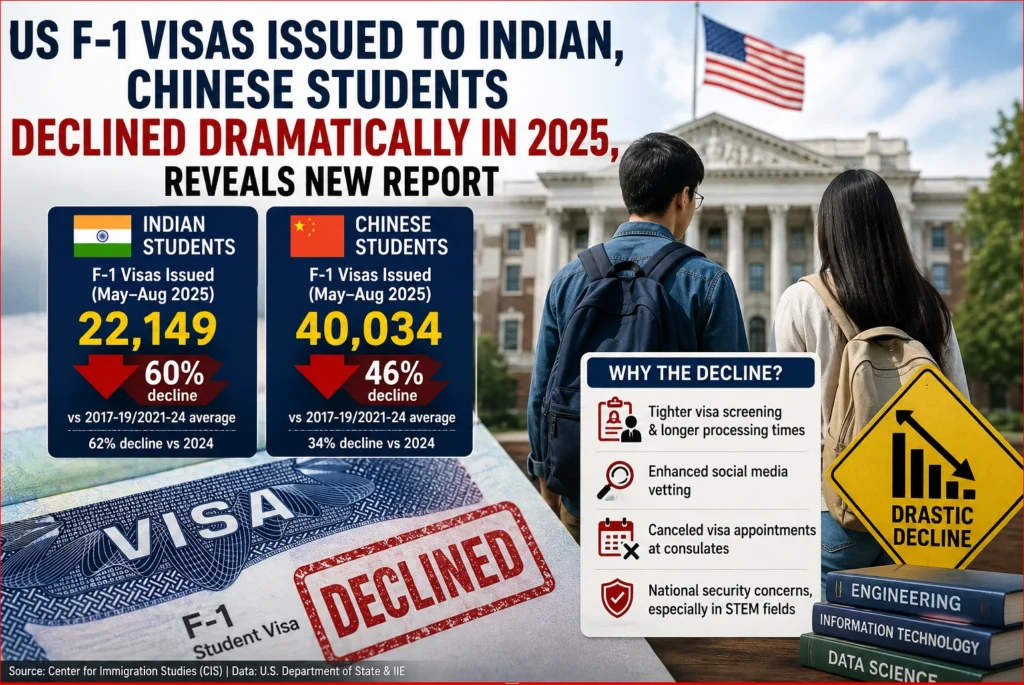
According to CIS data, the US issued 22,149 F-1 visas to Indian nationals between May and August 2025. That’s a 60% decline from the average number issued during the 2017-19 and 2021-24 periods, when the figure stood at 55,717. Compared to 2024 alone, when 58,694 visas were issued in the same window, the drop is even steeper a 62% year over year decline.
Chinese nationals weren’t spared either. F-1 visa issuances for Chinese students fell to 40,034 during the same May August 2025 period, marking a 46% decline from the 2017-19 and 2021-24 average of 73,853, and a 34% drop from the 61,075 visas issued in 2024.
The May-August window matters because it’s traditionally when the bulk of student visas get issued, ahead of the fall academic year. A sharp fall during this specific period signals real trouble for enrollment numbers heading into the new academic session.
Why This Matters
India and China aren’t just two countries among many sending students to the US together, they represent over half of the entire international student population. During the 2024-25 academic year, India had 363,019 students and China had 265,919 students studying in the US, out of a total of 1,177,766 foreign students nationwide, according to Institute of International Education (IIE) census data cited in the CIS report.
A decline of this scale isn’t just a statistic it has ripple effects. Universities depend on international tuition revenue. The US labor market benefits from the Optional Practical Training (OPT) program, which lets international graduates work in the US temporarily after finishing their degrees. Fewer incoming students today means fewer OPT participants a few years down the line.
What’s Driving the Decline
The drop comes against the backdrop of tighter visa screening and stricter immigration policies under the current administration. Enhanced social media vetting, canceled visa appointments at consulates, and longer processing times have all been cited as contributing factors. In June 2025, a presidential proclamation even sought to suspend the entry of new international students planning to study at Harvard University under F, M, and J visas, citing national security concerns a move that added to broader unease among prospective applicants.
For Chinese nationals specifically, the CIS report also raises national security concerns tied to STEM fields, pointing to risks around technology transfer. The report does note that it doesn’t view all Chinese students as security risks, but it still recommends reduced numbers on security grounds a stance that has drawn pushback from universities and civil rights groups worried about unfairly targeting an entire nationality.
The Bigger Picture
Not every country is seeing declines. Vietnam, Bangladesh, and Pakistan have actually seen increases in F-1 visas issued during the same period, suggesting that students from some regions are filling gaps left by reduced Indian and Chinese applications. Still, given the sheer size of the Indian and Chinese student populations in the US, no other country can realistically offset losses of this magnitude in the near term.
If the trend continues, US universities could face real enrollment and revenue pressure, while the broader tech and research sectors that rely on international STEM graduates may also feel the pinch.
FAQ
1. How much did F-1 visas for Indian students decline in 2025?
F-1 visas issued to Indian nationals fell to 22,149 between May and August 2025 — a 60% drop from the 2017-19/2021-24 average and a 62% decline compared to 2024.
2. How much did F-1 visas for Chinese students decline in 2025?
Chinese nationals received 40,034 F-1 visas in the same period, down 46% from the historical average and 34% lower than 2024 figures.
3. Who published this report?
The report was published by the Center for Immigration Studies (CIS), using visa data alongside enrollment figures from the Institute of International Education’s (IIE) annual census.
4. Why is the May-August period significant?
This four-month window typically sees the highest volume of student visa issuances each year, since most students need visas ahead of the fall academic term. A sharp decline here strongly signals lower fall enrollment.
5. What’s causing the decline?
Tighter visa screening, expanded social media vetting, canceled consulate appointments, and broader immigration restrictions under the current US administration are the main factors cited.
6. Are there national security concerns involved?
Yes, particularly for Chinese students in STEM fields. The CIS report flags risks around technology transfer, though it acknowledges not all Chinese students pose a security threat.
7. Which countries are gaining international students as India and China decline?
Vietnam, Bangladesh, and Pakistan have seen increases in F-1 visa issuances during the same period, though not enough to offset the scale of the Indian and Chinese decline.
8. What impact could this have on US universities and the economy?
Reduced international enrollment could hurt university tuition revenue and shrink the pipeline of graduates entering the Optional Practical Training (OPT) program, affecting the US labor market in STEM and other sectors.