
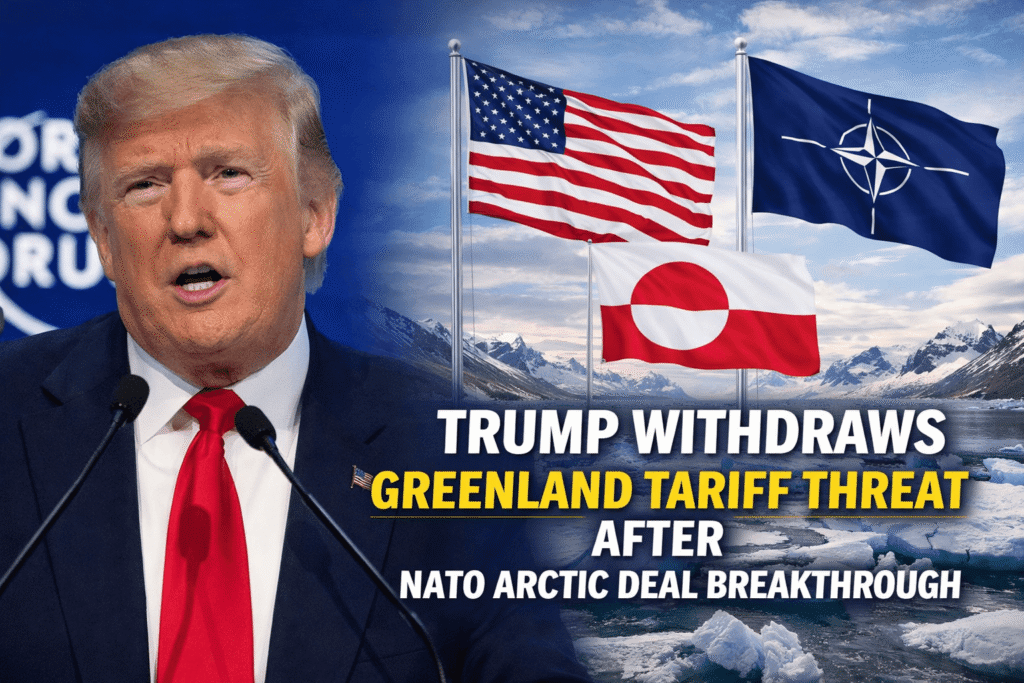
Trump Withdraws Greenland Tariff Threat After NATO Arctic Deal Breakthrough : It was a breath of relief for diplomats, markets, and everyday people alike when U.S. President Donald Trump unexpectedly withdrew his controversial Greenland tariff threat this week — a move that had sent shockwaves across Europe, NATO capitals, and global economic circles.
Just days ago, Trump had stunned the world by threatening steep tariffs on eight European nations, demanding support for U.S. ambitions around Greenland — a strategically critical Arctic territory and a linchpin in global geopolitics. His hard-edged rhetoric had triggered fears of a looming transatlantic trade war and unsettled global markets.
But on January 21, speaking at the World Economic Forum in Davos, Trump took a dramatic U-turn. He announced that after talks with NATO Secretary-General Mark Rutte, the United States and its allies have agreed on the “framework of a future deal” for Greenland and the wider Arctic region — and with that, the planned tariffs would no longer be applied.
This shift in tone — from confrontation to negotiation — offered a moment of relief for European leaders who had condemned Trump’s tariff threats and warned of retaliatory measures. Many had questioned whether the United States under Trump was pushing a new trade dispute with its closest allies, including Denmark, Germany, France, the UK, and the Netherlands.
Yet even with the tariff threat lifted, the story isn’t over. Danish and Greenlandic officials have been quick to clarify that no formal territorial deal or sale of Greenland has been made. Copenhagen has maintained that Greenland’s sovereignty is non-negotiable, and Nuuk’s leaders have emphasized that any cooperation must respect self-determination and Greenlandic identity.
Across the Atlantic, markets reacted swiftly: investors breathed easier as fears of a full-blown US-EU trade war receded, while the global focus shifted back to cooperation on Arctic security — particularly in light of rising geopolitical competition with Russia and China in the High North.
For many Greenlanders and Europeans who felt their voices were shaped by mass protests and international concern, this quieter path offered cautious optimism. The specter of tariffs and diplomatic rupture — once dominating headlines — has given way to dialogue and strategic partnership.
Still, critics argue that Trump’s earlier actions, including a brief flirtation with tariffs and aggressive language, strained trust between the United States and NATO — highlighting the fragility of alliances in an era of shifting global power balances.
In the end, the retreat from tariff threats and the embrace of an Arctic deal framework underscore a greater truth: when global tensions rise, it is cooperation — not confrontation — that will shape the future of Greenland, NATO relations, and the rapidly changing Arctic.
Disclaimer
This article is based on verified reports and public information as of January 22, 2026. It is intended for informational purposes only and does not represent an endorsement or political position.